In a recent Washington Post article Chris Matthews reports on a 4 year study that
smaller class size may help students progress in reading and math, but may
not close the achievement gap between class.
Saturday, March 15, 2008


Tuesday, March 04, 2008
New EL schools in New York City
* The Marsh Avenue Expeditionary Learning School, grades 6-8. Proposed
Principal: Jessica Jenkins-Milona.
* The McCown Expeditionary Learning School, grades 9-12. Proposed
Principal: Donna J. Tait.
Principal: Jessica Jenkins-Milona.
* The McCown Expeditionary Learning School, grades 9-12. Proposed
Principal: Donna J. Tait.
--
Sunday, March 02, 2008
Finnish Schools Score High
Sean sent me an article he found about Finnish Schools. He said, "It makes me want to move there." So they are scoring high on an international test. They don't have a very heterogeneous group like we do here in the states. One of the things he thought was cool was the way they have the gifted, or more advanced kids, help the average kids in the classroom instead of being pulled out or given extra work, which is sometimes done here in the states. This is something we are struggling with at CCPCS: How do we get all students involved in eachother's learning?
Saturday, November 17, 2007
Small Schools Aren't Good Enough
I have been reflecting on the recent CES Fall Forum in Denver. The overarching theme that I came away with was the inequity that still exists in small schools affiliated with the small school movement concerning English language learners or special education students.
In my critical friends conversation we discussed the question: What school design practices will ensure a continuum or range of services for children with special education needs and English Language Learner needs? I wanted to dig into this topic because of the many stories that I had been reading about how small schools were not obligated to provide services to these students in New York.
Our small group of 5 was a diverse group of special education teachers: June from Boston; Leanne, Lauren, and Heather from Lake Washington; Anita from Quest in Humble, Texas. June is the director of services for a small school. She is in charge of 70 students with either ELL or Special Ed needs. Anita is a Special Education Interventionist for a population of about 17 in middle school to high school. The three women from Lake Washington were special education content specialists and were planning for their school being converted into a smaller school. It seemed that all of these women came to the conversation to hear about what other programs looked like. They wanted to talk about their program and hear about how other small schools give services to this diverse population.
When I spoke about my school, Capital City Public Charter School in DC, the teachers were in awe. How can there be enough money to have an inclusion teacher for 13 students in 7th and 8th grade? How is there an hour planning time set aside each day? How do you get your teachers to differentiate their lessons?
I didn't have all the answers because a lot of things like scheduling and budgeting is done without my knowledge. But I do know that we have two teachers in each classroom at all times. I am the third teacher in Math and Humanities. It is a well oiled machined, as some say. I am in a great position. My students are in a better position. There is almost no way to fall through the cracks in a system like this. How do we get other Coalition schools, or any other school for that matter do what we do?
Do we need mandated special ed and ELL services? That isn't really what CES is about. Who has the answers?
In my critical friends conversation we discussed the question: What school design practices will ensure a continuum or range of services for children with special education needs and English Language Learner needs? I wanted to dig into this topic because of the many stories that I had been reading about how small schools were not obligated to provide services to these students in New York.
Our small group of 5 was a diverse group of special education teachers: June from Boston; Leanne, Lauren, and Heather from Lake Washington; Anita from Quest in Humble, Texas. June is the director of services for a small school. She is in charge of 70 students with either ELL or Special Ed needs. Anita is a Special Education Interventionist for a population of about 17 in middle school to high school. The three women from Lake Washington were special education content specialists and were planning for their school being converted into a smaller school. It seemed that all of these women came to the conversation to hear about what other programs looked like. They wanted to talk about their program and hear about how other small schools give services to this diverse population.
When I spoke about my school, Capital City Public Charter School in DC, the teachers were in awe. How can there be enough money to have an inclusion teacher for 13 students in 7th and 8th grade? How is there an hour planning time set aside each day? How do you get your teachers to differentiate their lessons?
I didn't have all the answers because a lot of things like scheduling and budgeting is done without my knowledge. But I do know that we have two teachers in each classroom at all times. I am the third teacher in Math and Humanities. It is a well oiled machined, as some say. I am in a great position. My students are in a better position. There is almost no way to fall through the cracks in a system like this. How do we get other Coalition schools, or any other school for that matter do what we do?
Do we need mandated special ed and ELL services? That isn't really what CES is about. Who has the answers?
Friday, August 10, 2007
Politicians Just Don't Get It
Teaching children to care.
Where do they come up with these ideas? Paying kids to pass tests would be ludicrous and would either create unbriddled competition that they don't need any more of, or leave the idea that they aren't learning for their own well-being but for the people who are paying them. This is just another way that politicians try to bring capitalism into the education system! This isn't the way to get them to care. NYC just needs to focus on their small school education system and educating ALL students in this system: ELL and Sped. Maybe the money could be used for staffing in those schools, not incentives for test scores.
Where do they come up with these ideas? Paying kids to pass tests would be ludicrous and would either create unbriddled competition that they don't need any more of, or leave the idea that they aren't learning for their own well-being but for the people who are paying them. This is just another way that politicians try to bring capitalism into the education system! This isn't the way to get them to care. NYC just needs to focus on their small school education system and educating ALL students in this system: ELL and Sped. Maybe the money could be used for staffing in those schools, not incentives for test scores.
Wednesday, August 01, 2007
NYC small schools in the news again
Ed Week has a new article this week on small schools in New York City. NYCSB is giving $45,000 for two years to hire a special education teacher.
Lyons Community School in NYC will open this year. It is one school that will receive funds to support 8 students with special support needs and 10 who require self-contained or inclusion support in the regular education classroom. I am so curious how they will staff this person in a 6-9 school.
"The Department of Education announced on Feb. 20, 2007, that Lyons is one of 10 new small schools to receive special funds to allow them to accomodate special education students in their first two years. The funds require that the school enroll at least eight students who require special education teacher support services (SETSS) and at least 10 who require a self-contained or collaborative team-teaching class."
New York’s Citywide Council on High Schools (CCHS) is involved and has filed a lawsuit with the Department of Education Civil Rights office.
Looks like the Gates foundation is also looking at the issue, but not specifically at the special education policy. They are looking at more of the population that has been low-performing or at-risk of receiving weak education. Maybe they should be looking more closely at the graduation rates related to ELL and Special ed students.
Lyons Community School in NYC will open this year. It is one school that will receive funds to support 8 students with special support needs and 10 who require self-contained or inclusion support in the regular education classroom. I am so curious how they will staff this person in a 6-9 school.
"The Department of Education announced on Feb. 20, 2007, that Lyons is one of 10 new small schools to receive special funds to allow them to accomodate special education students in their first two years. The funds require that the school enroll at least eight students who require special education teacher support services (SETSS) and at least 10 who require a self-contained or collaborative team-teaching class."
New York’s Citywide Council on High Schools (CCHS) is involved and has filed a lawsuit with the Department of Education Civil Rights office.
Looks like the Gates foundation is also looking at the issue, but not specifically at the special education policy. They are looking at more of the population that has been low-performing or at-risk of receiving weak education. Maybe they should be looking more closely at the graduation rates related to ELL and Special ed students.
Sunday, May 20, 2007
High School Expectations
From PEN Newsblast on April 19.

CLOSING THE "EXPECTATIONS GAP"

One-quarter of all states have implemented
significantly tougher graduation requirements,
and virtually every state has taken steps to
ratchet up expectations for high school students,
according to a national survey of high school
reform efforts conducted by Washington, D.C.
-based Achieve, Inc. The survey updates the
efforts of all 50 states to align their high
school standards, graduation requirements,
assessments, and accountability systems with
the demands of college and work, and finds that
at least 48 states are now actively engaged in
reform efforts of some kind. There is more
momentum in the states now than at any time
since education reform became a national priority
with the release of A Nation at Risk in 1983.
Some of the most dramatic progress has been made
in the area of graduation requirements, where 13
states, up from just two in 2004, now require high
school students to complete a college- and work-ready
curriculum in order to earn a diploma.  According
to the survey report, "Closing the Expectations Gap
2007", 16 additional states are taking steps to
implement similar graduation requirements, which
include four years of challenging mathematics at
least through Algebra II and four years of rigorous
English. States also have achieved significant
progress in making academic standards rigorous
enough in English and mathematics so that they
accurately reflect real world expectations, but
have moved more slowly in developing complementary
assessment systems and holding high schools
accountable for the college-readiness of their
students. "While the federal government has been
driving K-8 education policy, states are leading
the way on high school reform," said Michael Cohen,
president of Achieve. "This is a heavy lift for
governors, but their leadership is urgently needed
as states take the steps to prepare young people
to succeed in the global economy where good jobs
increasingly require some postsecondary education.
College-ready skills are a must for every high school
graduate today."
http://www.achieve.org/node/844
Tuesday, May 15, 2007
ELLs in Small Schools?!
EDweek article
I just entered a submission to the CES Fall Forum, a Principled Stand, which deals with the continuum of services that are or aren't being provided to students with specific learning needs (ELL or students with LDs). I am hoping that addressing the school design aspect will help other students who are lacking a full continuum of services and are stuck with fully including their students into the regular education classroom without appropriate supports because of the lack of budgeting for appropriate staff and/or instructional strategies. I know the issue is big in New York. In fact the article above references the first article that I read about the issue of small schools not allowing ELL students to come to the school for the first 2 years because of budget restraints. I guess the school could build itself up first and then once it was successful and had a core number of student admitted, it could then afford to hire an inclusion teacher.
I just entered a submission to the CES Fall Forum, a Principled Stand, which deals with the continuum of services that are or aren't being provided to students with specific learning needs (ELL or students with LDs). I am hoping that addressing the school design aspect will help other students who are lacking a full continuum of services and are stuck with fully including their students into the regular education classroom without appropriate supports because of the lack of budgeting for appropriate staff and/or instructional strategies. I know the issue is big in New York. In fact the article above references the first article that I read about the issue of small schools not allowing ELL students to come to the school for the first 2 years because of budget restraints. I guess the school could build itself up first and then once it was successful and had a core number of student admitted, it could then afford to hire an inclusion teacher.
Tuesday, May 01, 2007
More Small Scholl Benefits
Five Steps to Reducing the Black-White Achievement Gap
While misguided leaders have been calling for a cultural transformation to address the supposed “acting white” crisis, they have ignored far more important educational reforms:
1. Improving and expanding early childhood education. A large body of research shows that black students begin kindergarten behind white students. If we expand and improve the quality of the pre-kindergarten education received by black children we will significantly reduce the testing gap.
2. Improving teacher quality in black schools. A recent study by the Illinois Education Research Council found that 45 percent of black high school students in Illinois attended schools with the lowest teacher-quality ratings. Only 8 percent of white students attended such low teacher-quality schools. Until we eliminate the teacher-quality gap, we will have a test-score gap.
3. Providing small classes and creating small schools. Black students, who are often behind, benefit from the extra attention available in very small classes. Reductions in class size have been shown to boost black student achievement. Smaller schools have been shown to increase black students’ graduation rates.
4. Increasing school integration. While black leaders have been condemning black students based on flawed “acting white” research, America’s schools have been becoming increasingly segregated. Few black leaders have said a word about this issue. Yet historically, integration has been one means by which blacks have gained access to higher quality schools. Effective school integration can also help break down the racial stereotypes of whites and blacks.
5. Making college more affordable. Research suggests that if college were more affordable there would be higher black college enrollment and graduation rates.
http://www.blacknews.com/pr/actingwhite101.html
Monday, February 19, 2007
SIOP vs. UDL
SIOP Sheltered Intervention Observation Protocol vs. UDL Universal Design for Learning
What are the differences and similarities?
Both look as though they are models to help move away from the traditional pedagogical approach of lesson delivery.
Do we have time at CCPCS to delve into this, or do we need to just stick with our ELOB prinicples and let them guide our pedagogy?
I think we need something more focused for the inclusive classroom in which CCPCS philosophically believes.
What are the differences and similarities?
Both look as though they are models to help move away from the traditional pedagogical approach of lesson delivery.
Do we have time at CCPCS to delve into this, or do we need to just stick with our ELOB prinicples and let them guide our pedagogy?
I think we need something more focused for the inclusive classroom in which CCPCS philosophically believes.
Breaking up Big Schools
In a recent article in the New York Times, it was brought to my attention that there are programs for ELL and special ed students that are obsolete after large schools with these particular programs are broken up into smaller schools.
The immigrant city and community should be taken into account. What do they want for their students? Do they want inclusion or do they want special programs? This is definately one of the areas that I feel is taken for granted when we think about breaking up our larger schools, or even when we create new small schools. And furthermore, when we create our small schools, how do we ensure that we are listening to all stakeholders as we create new instructional programs? We must listen to the community. What do they need and how can we meet their needs?
It says, ~Then, a few weeks ago, the department announced its plan for restructuring Lafayette, which now has about 2,100 students, beginning in September 2007. It would contain three new schools — one emphasizing sports management, another focusing on film and music, and a third offering “expeditionary learning” under the aegis of Outward Bound. None will offer bilingual instruction, at least at the outset.
“This is an absolutely unacceptable choice,” Mr. Chung said. “These three schools have nothing to do with our community. They’re forcing the immigrant students out of their own neighborhood. New York is an immigrant city, but I think the education policy is not for us.”
___The immigrant city and community should be taken into account. What do they want for their students? Do they want inclusion or do they want special programs? This is definately one of the areas that I feel is taken for granted when we think about breaking up our larger schools, or even when we create new small schools. And furthermore, when we create our small schools, how do we ensure that we are listening to all stakeholders as we create new instructional programs? We must listen to the community. What do they need and how can we meet their needs?
Saturday, November 11, 2006
Students and Achievement
My current obsession is about students, of course. But how do we get all students, black, white, special ed, ELL, to connect to the content meaningfully. Yes, cater to their individual strengths. But there is more to that. In a full classroom with 24 students, each with their own background baggage, current identity, strengths and weaknesses, how do we connect topics such as the Civil War to these diverse middle school students trying so hard to connect with their own identity, let alone a story about an actual soldier in the Union army, for example.
Why reinvent the wheel when people have done the research? Attempt a new pedagogical practice and reflect on the results I think that is the research that I am doing now: Do classrooms really need three teachers?I am beginning to understand, through my experince as a "third wheel" in the classroom, that it doesn't take more teachers in the classroom, it takes establishing well researched pedagogical practices and routines into your teaching ___.
How do you connect teaching with activism and social change? Expeditions! CCPCS is an Expeditionary Learning School where this should already be embedded in the teacher's pedagogy.
So, let's examine this relationship: teaching for social change and expeditions. When planning an expedition, the main question one asks after "What content will I need to teach?" is "How will my students have a puposeful audience for their projects that are a result of the expedition?" If my co-teacher's and I had really thought about this, (and we "thought" about it, but didn't really act on it) we should have related the expedition on Slavery and the Civil War on meaningfully connecting the content to current social conditions.
"Our goals for ourselves and for our students are as complex, dynamic, and contested as we hope their goals will be as teachers of children: to learn to see students fully and fairly, as threedimensional creatures much like ourselves; to see ourselves as active agents of change in our schools and in our worlds; and to find practical application in public school classrooms for our commitment to social justice and human freedom." (Ayers, W., Michie, G., Rome, A., "Embers of Hope: In Search of a Meaningful Critical Pedagogy", Teacher Education Quarterly, Winter 2004, online google article)
CREDE - Center for Research on Education, Diversity, and Excellence has 5 Standards that establish another set pf principles that should guide insturction to individuals who are "at risk of educational failure due to cultural, language, racial, geographic, or economic factors." They are:
Teachers and students work together (collaboration between students and teachers)
developing language and literacy across all curriculum (integrated curriculum),
connecting lessons to students lives (meaningful, authentic, relevant connections to curriculum),
engaging students with challenging lessons (complex, higher-order thinking)
emphasizing dialogue over lectures (critical pedagogy, student-as-worker, teacher-as-coach (CES principle))
http://crede.berkeley.edu/standards/standards.html
How do you connect teaching with activism and social change? Expeditions! CCPCS is an Expeditionary Learning School where this should already be embedded in the teacher's pedagogy.
So, let's examine this relationship: teaching for social change and expeditions. When planning an expedition, the main question one asks after "What content will I need to teach?" is "How will my students have a puposeful audience for their projects that are a result of the expedition?" If my co-teacher's and I had really thought about this, (and we "thought" about it, but didn't really act on it) we should have related the expedition on Slavery and the Civil War on meaningfully connecting the content to current social conditions.
"Our goals for ourselves and for our students are as complex, dynamic, and contested as we hope their goals will be as teachers of children: to learn to see students fully and fairly, as threedimensional creatures much like ourselves; to see ourselves as active agents of change in our schools and in our worlds; and to find practical application in public school classrooms for our commitment to social justice and human freedom." (Ayers, W., Michie, G., Rome, A., "Embers of Hope: In Search of a Meaningful Critical Pedagogy", Teacher Education Quarterly, Winter 2004, online google article)
CREDE - Center for Research on Education, Diversity, and Excellence has 5 Standards that establish another set pf principles that should guide insturction to individuals who are "at risk of educational
Teachers and students work together (collaboration between students and teachers)
developing language and literacy across all curriculum (integrated curriculum),
connecting lessons to students lives (meaningful, authentic, relevant connections to curriculum),
engaging students with challenging lessons (complex, higher-order thinking)
emphasizing dialogue over lectures (critical pedagogy, student-as-worker, teacher-as-coach (CES principle))
http://crede.berkeley.edu/standards/standards.html
Saturday, September 16, 2006
Focusing on Strengths
I have always thought that it was important for students to know their strengths to be better learners. I haven't ever thought that it would relate to knowing myself, and that my strengths could help me as a learner, an educator, or any of my other identifiers.
In 2003, for FCPS, by filling out a survey, I found out what my strengths were. And until recently, with help from my dad, I realized that I maybe should focus on these so as not to kill myself trying to be someone I am not. For instance, I want to be more assertive, but if that isn't my strength then I should not give myself a hard time if I am not. (My father denies I have any problem with this.) So here are my stregths (as of 2003):
from Now, Discover your strengths, Clifton and Buckingham (2001), http://Strengthsfinder.com
Maximizer
Excellence, not average, is your measure. Taking something from below average to slightly above average takes a great deal of effort and in your opinion is not very rewarding. Transforming something strong into something superb takes just as much effort but is much more thrilling. Strengths, whether yours or someone else's, fascinate you. Like a diver after pearls, you search them out, watching for the telltale signs of a strength. A glimpse of untutored excellence, rapid learning, a skill mastered without recourse to steps-all these are clues that a strength may be in play. And having found a strength, you feel compelled to nurture it, refine it, and stretch it toward excellence. You polish the pearl until it shines. This natural sorting of strengths means that others see you as discriminating. You choose to spend time with people who appreciate your particular strengths. Likewise, you are attracted to others who seem to have found and cultivated their own strengths. You tend to avoid those who want to fix you and make you well rounded. You don't want to spend your life bemoaning what you lack. Rather, you want to capitalize on the gifts with which you are blessed. It's more fun. It's more productive. And, counterintuitively, it is more demanding.
Woo
Woo stands for winning others over. You enjoy the challenge of meeting new people and getting them to like you. Strangers are rarely intimidating to you. On the contrary, strangers can be energizing. You are drawn to them. You want to learn their names, ask them questions, and find some area of common interest so that you can strike up a conversation and build rapport. Some people shy away from starting up conversations because they worry about running out of things to say. You don't. Not only are you rarely at a loss for words; you actually enjoy initiating with strangers because you derive satisfaction from breaking the ice and making a connection. Once that connection is made, you are quite happy to wrap it up and move on. There are new people to meet, new rooms to work, new crowds to mingle in. In your world there are no strangers, only friends you haven't met yet-lots of them.
Positivity
You are generous with praise, quick to smile, and always on the lookout for the positive in the situation. Some call you lighthearted. Others just wish that their glass were as full as yours seems to be. But either way, people want to be around you. Their world looks better around you because your enthusiasm is contagious. Lacking your energy and optimism, some find their world drab with repetition or, worse, heavy with pressure. You seem to find a way to lighten their spirit. You inject drama into every project. You celebrate every achievement. You find ways to make everything more exciting and more vital. Some cynics may reject your energy, but you are rarely dragged down. Your Positivity won't allow it. Somehow you can't quite escape your conviction that it is good to be alive, that work can be fun, and that no matter what the setbacks, one must never lose one's sense of humor.
Futuristic
"Wouldn't it be great if . . ." You are the kind of person who loves to peer over the horizon. The future fascinates you. As if it were projected on the wall, you see in detail what the future might hold, and this detailed picture keeps pulling you forward, into tomorrow. While the exact content of the picture will depend on your other strengths and interests-a better product, a better team, a better life, or a better world-it will always be inspirational to you. You are a dreamer who sees visions of what could be and who cherishes those visions. When the present proves too frustrating and the people around you too pragmatic, you conjure up your visions of the future and they energize you. They can energize others, too. In fact, very often people look to you to describe your visions of the future. They want a picture that can raise their sights and thereby their spirits. You can paint it for them. Practice. Choose your words carefully. Make the picture as vivid as possible. People will want to latch on to the hope you bring.
Communication
You like to explain, to describe, to host, to speak in public, and to write. This is your Communication theme at work. Ideas are a dry beginning. Events are static. You feel a need to bring them to life, to energize them, to make them exciting and vivid. And so you turn events into stories and practice telling them. You take the dry idea and enliven it with images and examples and metaphors. You believe that most people have a very short attention span. They are bombarded by information, but very little of it survives. You want your information-whether an idea, an event, a product's features and benefits, a discovery, or a lesson-to survive. You want to divert their attention toward you and then capture it, lock it in. This is what drives your hunt for the perfect phrase. This is what draws you toward dramatic words and powerful word combinations. This is why people like to listen to you. Your word pictures pique their interest, sharpen their world, and inspire them to act.
In 2003, for FCPS, by filling out a survey, I found out what my strengths were. And until recently, with help from my dad, I realized that I maybe should focus on these so as not to kill myself trying to be someone I am not. For instance, I want to be more assertive, but if that isn't my strength then I should not give myself a hard time if I am not. (My father denies I have any problem with this.) So here are my stregths (as of 2003):
from Now, Discover your strengths, Clifton and Buckingham (2001), http://Strengthsfinder.com
Maximizer
Excellence, not average, is your measure. Taking something from below average to slightly above average takes a great deal of effort and in your opinion is not very rewarding. Transforming something strong into something superb takes just as much effort but is much more thrilling. Strengths, whether yours or someone else's, fascinate you. Like a diver after pearls, you search them out, watching for the telltale signs of a strength. A glimpse of untutored excellence, rapid learning, a skill mastered without recourse to steps-all these are clues that a strength may be in play. And having found a strength, you feel compelled to nurture it, refine it, and stretch it toward excellence. You polish the pearl until it shines. This natural sorting of strengths means that others see you as discriminating. You choose to spend time with people who appreciate your particular strengths. Likewise, you are attracted to others who seem to have found and cultivated their own strengths. You tend to avoid those who want to fix you and make you well rounded. You don't want to spend your life bemoaning what you lack. Rather, you want to capitalize on the gifts with which you are blessed. It's more fun. It's more productive. And, counterintuitively, it is more demanding.
Woo
Woo stands for winning others over. You enjoy the challenge of meeting new people and getting them to like you. Strangers are rarely intimidating to you. On the contrary, strangers can be energizing. You are drawn to them. You want to learn their names, ask them questions, and find some area of common interest so that you can strike up a conversation and build rapport. Some people shy away from starting up conversations because they worry about running out of things to say. You don't. Not only are you rarely at a loss for words; you actually enjoy initiating with strangers because you derive satisfaction from breaking the ice and making a connection. Once that connection is made, you are quite happy to wrap it up and move on. There are new people to meet, new rooms to work, new crowds to mingle in. In your world there are no strangers, only friends you haven't met yet-lots of them.
Positivity
You are generous with praise, quick to smile, and always on the lookout for the positive in the situation. Some call you lighthearted. Others just wish that their glass were as full as yours seems to be. But either way, people want to be around you. Their world looks better around you because your enthusiasm is contagious. Lacking your energy and optimism, some find their world drab with repetition or, worse, heavy with pressure. You seem to find a way to lighten their spirit. You inject drama into every project. You celebrate every achievement. You find ways to make everything more exciting and more vital. Some cynics may reject your energy, but you are rarely dragged down. Your Positivity won't allow it. Somehow you can't quite escape your conviction that it is good to be alive, that work can be fun, and that no matter what the setbacks, one must never lose one's sense of humor.
Futuristic
"Wouldn't it be great if . . ." You are the kind of person who loves to peer over the horizon. The future fascinates you. As if it were projected on the wall, you see in detail what the future might hold, and this detailed picture keeps pulling you forward, into tomorrow. While the exact content of the picture will depend on your other strengths and interests-a better product, a better team, a better life, or a better world-it will always be inspirational to you. You are a dreamer who sees visions of what could be and who cherishes those visions. When the present proves too frustrating and the people around you too pragmatic, you conjure up your visions of the future and they energize you. They can energize others, too. In fact, very often people look to you to describe your visions of the future. They want a picture that can raise their sights and thereby their spirits. You can paint it for them. Practice. Choose your words carefully. Make the picture as vivid as possible. People will want to latch on to the hope you bring.
Communication
You like to explain, to describe, to host, to speak in public, and to write. This is your Communication theme at work. Ideas are a dry beginning. Events are static. You feel a need to bring them to life, to energize them, to make them exciting and vivid. And so you turn events into stories and practice telling them. You take the dry idea and enliven it with images and examples and metaphors. You believe that most people have a very short attention span. They are bombarded by information, but very little of it survives. You want your information-whether an idea, an event, a product's features and benefits, a discovery, or a lesson-to survive. You want to divert their attention toward you and then capture it, lock it in. This is what drives your hunt for the perfect phrase. This is what draws you toward dramatic words and powerful word combinations. This is why people like to listen to you. Your word pictures pique their interest, sharpen their world, and inspire them to act.
Catching up
email to lainey
Sean is getting closer and closer to being finished. The other day, he picked me up from the metro and we were talking and he said, "Yeah, I have outlined the disertation." It sort of hit me that he is so close, and that means we might be moving somewhere else in a few years. I am getting so used to being here. I really love it here, so it will be hard to leave. But that won't be for at least two years. Even if he finishes in the next year and a half, I am going to apply to work as an administrator in the new Upper School for Capital City. I have been working on the steering committee and planning the curriculum, going to conferences, etc. It has been a great learning expericence and has given me an opportunity to learn about creating schools, especially Coalition Schools. They have such a great philosophy for teaching and school design. Anyway, it has been exciting and tiring all at the same time.
Sunday, August 06, 2006
Summer time
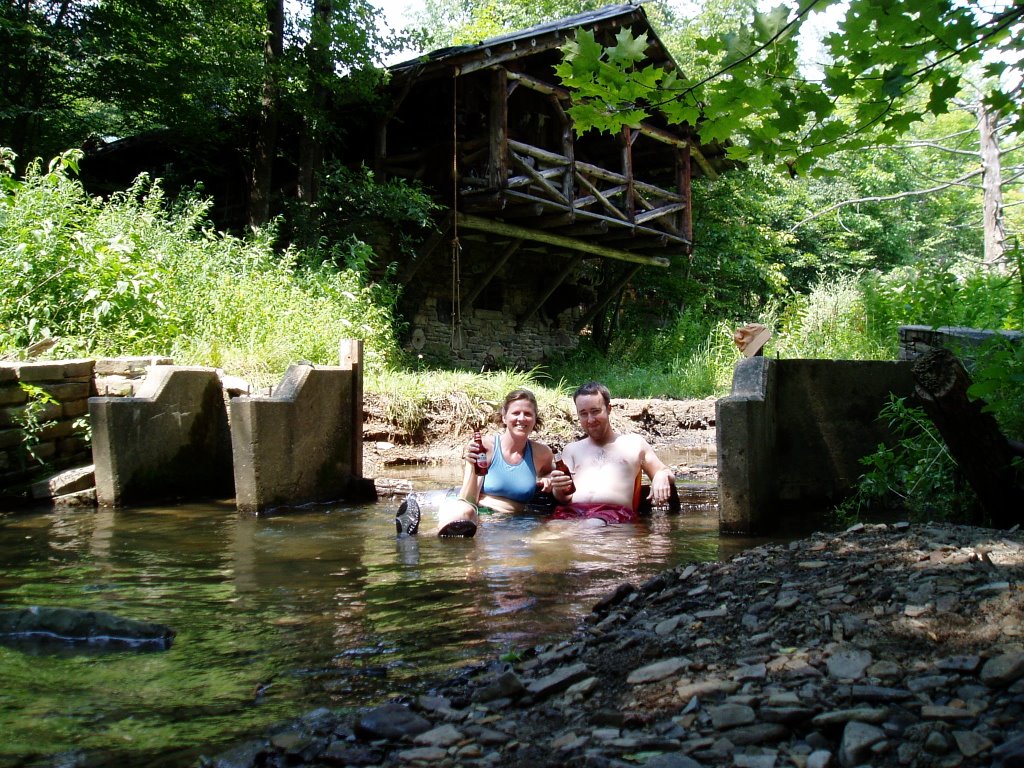
This summer, Sean and I wanted to spend our time in the woods again. Last summer it was in TN, this summer it was to cooler air in NY state. We went to Letchworth State Park with Jeff and Michelle from Waterloo, Ontario. Then traveled down a scenic road to the Pollywogg Holler for an Eco-Lodge experience we will never forget. Lastly, we traveled East to Hudson, NY to see Doug and Rachel. We had such an energizing time seeing old friends and making new ones.
Saturday, April 08, 2006
You can learn a lot from your grandmother!
Experience shapes who we are as individuals and is important to use as valuable means of connection; connection to self, others, and education. bell hooks (1994) would also argue that pedagogical practices in higher education should change so that our students learn to engage more fully the ideas and issues that actually do have relation to their experience: “Critical pedagogies of liberation respond to these concerns and necessarily embrace experience, confessions and testimony as relevant ways of knowing, as important, vital dimensions of any learning process” (p. 89).
Have you ever listened to a story about your grandmother, or great grandmother? These histories provide valuable learning opportunities. These experiences, positive or negative, are what shapes individual identity. We must listen to our histories, ask questions, and talk about our experiences with our families, our teachers and students to begin to connect and learn about each other and on a larger scale, connect with our peers in formal educational settings. Any experience could be a priceless lesson. Experiences shape who our students and families are and who we are as individuals. With better a knowledge and understanding of who we are we, formal classroom settings should allow students and teachers to speak from the voice of experience and connect in different ways. Consequently when pedagogical practices allow for this type of connection to take place it helps students own their understanding about subjects being studied. Unfortunately this is not usually the case. Families do not listen to each other, students are silenced when they question what they are learning, and teachers adopt what Paolo Friere calls the banking model as pedagogy in the classrooms.
As a woman it is even more important that my pedagogical practice changes so that I don’t silence myself or my students and our experiences as women and men are validated as culturally distinct (even where essentially similar) and pertinent to educational experience for all. Women and men are different, not just in sex characteristics, but in how professors often shape their pedagogical practices towards suppressing differences in how each gender learns. Ultimately, pedagogy tends to genderize traits negatively towards females Jane Roland Martin (1985) says we must worry about trait genderization and how it is used in informal and formal institutions to maintain the male dominating hierarchical structure.
"Otherwise we can expect females to continue to be caught in the middle of a war between educational goals and processes based on the assumption that sex is a difference that makes no difference, on the one hand, and cultural images and expectations that assume sex is the difference that makes that makes a difference, on the other hand (p. 36)."
It is not our sex, but our differences in learning who we are and how we learn from our experiences as men and women in cultures that insist on there being a difference that should also be considered.
As mentioned above it is especially important in university settings because, often, there is one kind of learning that is privileged. Adrienne Rich (1979) asserts that white male experience is taught in the universities.
"One of the devastating weaknesses of university learning, of the store of knowledge and opinion that has been handed down through academic training, has been its almost total erasure of women’s experience and thought from the curriculum, and its exclusion of women as members of the academic community (p. 232)."
In order to investigate the claim that people identifying with different genders learn differently, while simultaneously valuing experience as a learning tool, I conducted a few informal interviews, the most important of which was with my grandmother. This project of looking at my grandmother’s experiences under the microscope is about exploring more about where my ways of knowing come from; why is listening to my grandmother’s voice so important? How does it shape my mission to change current pedagogical practices to be more inclusive and open to listening to experience within the classroom?
When I was younger, I did not know why it was so important that my grandmother told stories about her family. I didn’t see the value of her experience; Now I believe I value this more because I see that my grandmother knows more about what would shape my identity. By sharing the family’s history and most importantly the choices women made in the family, my grandmother was teaching me about who we were and most importantly how we should respect the experiences and choices that women make. For example, she respects my decision to stay in school rather than start a family, as I respect her decision to stay with her mother rather than go to college. This is similar to what the authors of Women’s Ways of Knowing speaks about:
"Both the story and the actualities of family life change because parents and children evolve in tandem, supporting and challenging each other to develop ever more complex ways of knowing as they play out their lives together. Children encourage the development of parents as much as parents encourage the development of children (Belenky et. al., 1997, p 156)."
This is the process of how informal education takes place. My goal is to get teachers to acknowledge the process of supporting and challenging each other in developing ways of knowing. What the authors of Women’s Ways of Knowing suggest happens in informal settings can also happen between students and teachers. This idea is exemplified in my interview with my grandmother.
During the interview I asked her about what she remembers about education growing up in the small town of Jonesboro, Texas. I asked Nanny if education was important. She answered emphatically:
Yes, it was…My mother was a fairly educated women for her day. My father wasn’t. But she had actually gone to college a little. She went to Tyler Junior College. Then her father became ill and she returned home. There was nobody left at home but boys, two little boys. Her other sisters had gotten married. Her mother had died from childbirth complications at age forty-two and I don’t blame her. She had to feed [all those children] and take care of the farm. Women were slaves…taking care of the farm, and they even milked the cow…It was a hard job being on the farm. [When she was younger, my mother’s] sisters taught her how to be a good housekeeper, seamstress, and all that.. She was one of 10 or so kids.
My grandmother insists that education was important because of the role education played in her own mother’s informal and formal schooling. Below, she only speaks of only formal schooling when I ask her to describe her education:
We didn’t have a big school, probably about 100 kids 1-11 grade. We had fun and we loved our teachers. We played ball. No one got in trouble we just had fun. There were some parents who kept their children to pick cotton, but they needed them to help out. When ever we got through with school we would go home and help pick cotton and make some money. My mother never kept us out of school. That is how much it meant to her.
My grandmother never went to college and she regrets not going. In fact, she even calls herself stupid about not going. This is not the first time I have heard my grandmother call herself stupid.
Certainly I have regretted that all my life because I loved to learn. The deal was we were stupid. [Mother and I] moved to Hamilton. If we had just moved to Stephenville where the college was. We were stupid not to go to Stephenville. We didn’t think of it. If we had of I probably would have gone to school. She might of, too. That is how much she thought it was important. We can’t rewrite a book over. But I did go to school later…out at TCJC [Tarrant County Junior College] sometimes, just as a senior citizen or to Weatherford College.
My grandmother describes herself before she had children, “I never did have much of a care free life because mother and I were alone. We had to take care of the farm by ourselves after dad left.” Indeed, a woman who has experienced such pain in her life as a father abandoning her and feeling an overwhelming pressure to care for her mother would have much to say about the differences between men and women. This is what shapes my grandmother’s identity and who she is right now. These are experiences that are not only in my grandmother’s sphere but also in other women’s worlds and they need to be listened to and shared. They are the testimonies that bell hooks refers to above. There is value in both the informal and formal education my grandmother was incapable of claiming which is why she denigrates herself and calls herself stupid.
When I asked my grandfather who the smartest person he knew was, he said,
Nanny…she is the smartest person I know. She knows just about everything. she can explain everything. If it hadn’t have been for mom, we wouldn’t have been here today. Even though I made a lot of things happen, she helped me along the way. I think she is the best thing that ever happened to me.
Nanny did help Pa along the way; she helped him with his contracting business by managing books and dealing with clients. She has proved her “smarts” often so that even the whole family knows she is a very intelligent woman with many experiences to share—one’s that I value more now.
If my grandmother had been a women who was interviewed by Belenky, Clinchy, Goldberger, and Tarule (1997) in Women’s Ways of Knowing, she would have been included in what they call the “received knowers” epistemological position. She remained self-less in devotion to others.
"Thinking that everything must be ‘either/or,’ the received knowers assume that in times of conflict between the self and others, they must choose one or the other but not both. Women worry that if they were to develop their own powers it would be a the expense of others. Not only are they concerned to live up to the cultural standards that hold that women should be listeners, subordinate, and unassertive; but they also worry that if they excel, those they love will automatically be penalized…Men choose the self and women choose others (Belenky et. al., 1997, p. 46)."
My grandmother understands that men are more about self than women. She refers to this difference concerning the experiences that they each are allowed to have depending on men and their “freedom” to make choices. When I asked my grandmother what it meant to be a man and a woman, she responded,
[Being a man] means freedom; freedom to leave four children with a sick wife. (meaning her dad) But it also means you have a lot of responsibility. It overpowers men to have five people depending on you and you having to clothe them. I think my father was just mentally ill and he just left. But also it could be like Pa. He got up about four thirty every morning to go to work. He had four children and had lots of fun with a lake house and giving them presents. Every man stands unto himself, makes what he wants to out of life.
A woman starts out as a baby girl, then grows up because of the culture she’s in that she is the caretaker of the family and her world. Many girls don’t feel that way and don’t have to, and I am not talking about everybody, only myself. They grow up and have kids and grandkids for their own.
This knowledge that my grandmother has gives voice to other women who have similar feelings of being silenced by the knowledge that for women it is about caring for others.
Belenky, Clinchy, Goldberger, and Tarule (1997) describe their definition of voice and silence: “By telling us about their voice and silences, by revealing to us how much they could hear and learn from the ordinary and everyday, women told us about their views of the world and their place in it” (p. 19). Now after hearing my grandmother explain her decision to stay with her mom instead of going to college, I am less frustrated with the circumstances and more respectful of her decision out of strength in making that choice. She does not see it that way, however. In fact my grandmother is clear that she lived in silence to keep her family together. My grandmother told me during a recent visit back to Texas that she thinks staying silent through stressful times in her marriage gave her breast cancer therefore she is more aware of her self, her feelings, and how powerful voice can be.
When I asked my grandmother how she sees herself now, she talks about her experience as a mother: her three sons and daughter were her life. Indeed, this is the experience of which she is most proud: “I have some regrets because I didn’t go to school. I still learned and read and wrote. I feel that my children were my life. And I did a great job. They had excellent citizenship marks in school. They were very respectful.” While my grandmother measures her accomplishments with the citizenship marks her children made in school, I believe that a woman’s responsibility is more of what Adrienne Rich (1979) articulates,
"Responsibility to yourself means refusing to let others do your thinking, talking, and naming for you…Responsibility to yourself means that you don’t fall for shallow and easy solutions—predigested books and ideas, weekend encounters guaranteed to change your life, taking ‘gut’ courses instead of ones you know will challenge you, bluffing at school and life instead of doing solid work, marrying early as an escape from real decisions, getting pregnant as an evasion of already existing problems (p.233-234)."
Women will continue listening to other people’s experiences, connecting and learning from these experiences. More importantly what I have learned from this exploration of my grandmother’s experiences is that voice and experience has a place in not only informal settings but in formal classrooms. This type of experience is valuable and instructors should make every effort to value it. One way of doing this is through what Belenky, Clinchy, Goldberger, and Tarule (1997) call “the connected class.”
"The connected class recognizes the core of truth in the subjectivist view that each of us has a unique perspective that is in some sense irrefutably ‘right’ by virtue of its existence. But the connected class transforms these private truths into ‘objects,‘ publicly available to the members of the class who, through ‘stretching and sharing,’ add to themselves as knowers by absorbing in their own fashion of their classmates’ ideas (p. 223)."
This type of connected class is a change in how traditional college classrooms are held. As bell hooks (1994) suggests, “Allow your students, or yourself [as professor or teacher], to talk about experience; sharing personal narratives yet linking that knowledge with academic information really enhances our capacity to know” (p. 148). She elaborates that when one comes to their own voice in the act of telling about their own experience you can begin to speak freely about other subjects like race, class, and language (hooks, 1994). Connected teaching allows student and teachers alike to gain a stronger voice of subjective knowledge. That voice when allowed to speak from experience will help students grow and begin to feel more a part of their own learning as a person rather than an objective listener. Teachers need to open up their classrooms to allow personal experience in and allow opportunities to connect that experience with the subjects being learned. True learning can only take place when connections are made; connections between people and the texts they might be reading. When students are allowed to share their voice of experience, knowledge and experiences are shared without dominating or suppressing pedagogical practice, they begin questioning which is critical in connecting and understanding the subject.
References
Interview. Wilmuth Mavinee Box Johnson. November 21, 2004.
Interview. Lester Lee Johnson. November 21, 2004
Belenky, M. F., Clinchy, B. M., Goldberger, N. R., & Tarule, J. M. (1997). Women's Ways of Knowing: The Development of Self, Voice, and Mind. New York: BasicBooks.
hooks, b. (1994). Teaching to Transgress: Education as the Practice of Freedom. New York: Routledge.
Martin, J. R. (1985). Reclaiming a Conversation: The Ideal of the Educated Woman. New Haven: Yale University Press.
Rich, A. (1979). Claiming and Education. In On Lies, Secrets, and Silence (pp. 231-235). New York: W. W. Norton & Company.
Have you ever listened to a story about your grandmother, or great grandmother? These histories provide valuable learning opportunities. These experiences, positive or negative, are what shapes individual identity. We must listen to our histories, ask questions, and talk about our experiences with our families, our teachers and students to begin to connect and learn about each other and on a larger scale, connect with our peers in formal educational settings. Any experience could be a priceless lesson. Experiences shape who our students and families are and who we are as individuals. With better a knowledge and understanding of who we are we, formal classroom settings should allow students and teachers to speak from the voice of experience and connect in different ways. Consequently when pedagogical practices allow for this type of connection to take place it helps students own their understanding about subjects being studied. Unfortunately this is not usually the case. Families do not listen to each other, students are silenced when they question what they are learning, and teachers adopt what Paolo Friere calls the banking model as pedagogy in the classrooms.
As a woman it is even more important that my pedagogical practice changes so that I don’t silence myself or my students and our experiences as women and men are validated as culturally distinct (even where essentially similar) and pertinent to educational experience for all. Women and men are different, not just in sex characteristics, but in how professors often shape their pedagogical practices towards suppressing differences in how each gender learns. Ultimately, pedagogy tends to genderize traits negatively towards females Jane Roland Martin (1985) says we must worry about trait genderization and how it is used in informal and formal institutions to maintain the male dominating hierarchical structure.
"Otherwise we can expect females to continue to be caught in the middle of a war between educational goals and processes based on the assumption that sex is a difference that makes no difference, on the one hand, and cultural images and expectations that assume sex is the difference that makes that makes a difference, on the other hand (p. 36)."
It is not our sex, but our differences in learning who we are and how we learn from our experiences as men and women in cultures that insist on there being a difference that should also be considered.
As mentioned above it is especially important in university settings because, often, there is one kind of learning that is privileged. Adrienne Rich (1979) asserts that white male experience is taught in the universities.
"One of the devastating weaknesses of university learning, of the store of knowledge and opinion that has been handed down through academic training, has been its almost total erasure of women’s experience and thought from the curriculum, and its exclusion of women as members of the academic community (p. 232)."
In order to investigate the claim that people identifying with different genders learn differently, while simultaneously valuing experience as a learning tool, I conducted a few informal interviews, the most important of which was with my grandmother. This project of looking at my grandmother’s experiences under the microscope is about exploring more about where my ways of knowing come from; why is listening to my grandmother’s voice so important? How does it shape my mission to change current pedagogical practices to be more inclusive and open to listening to experience within the classroom?
When I was younger, I did not know why it was so important that my grandmother told stories about her family. I didn’t see the value of her experience; Now I believe I value this more because I see that my grandmother knows more about what would shape my identity. By sharing the family’s history and most importantly the choices women made in the family, my grandmother was teaching me about who we were and most importantly how we should respect the experiences and choices that women make. For example, she respects my decision to stay in school rather than start a family, as I respect her decision to stay with her mother rather than go to college. This is similar to what the authors of Women’s Ways of Knowing speaks about:
"Both the story and the actualities of family life change because parents and children evolve in tandem, supporting and challenging each other to develop ever more complex ways of knowing as they play out their lives together. Children encourage the development of parents as much as parents encourage the development of children (Belenky et. al., 1997, p 156)."
This is the process of how informal education takes place. My goal is to get teachers to acknowledge the process of supporting and challenging each other in developing ways of knowing. What the authors of Women’s Ways of Knowing suggest happens in informal settings can also happen between students and teachers. This idea is exemplified in my interview with my grandmother.
During the interview I asked her about what she remembers about education growing up in the small town of Jonesboro, Texas. I asked Nanny if education was important. She answered emphatically:
Yes, it was…My mother was a fairly educated women for her day. My father wasn’t. But she had actually gone to college a little. She went to Tyler Junior College. Then her father became ill and she returned home. There was nobody left at home but boys, two little boys. Her other sisters had gotten married. Her mother had died from childbirth complications at age forty-two and I don’t blame her. She had to feed [all those children] and take care of the farm. Women were slaves…taking care of the farm, and they even milked the cow…It was a hard job being on the farm. [When she was younger, my mother’s] sisters taught her how to be a good housekeeper, seamstress, and all that.. She was one of 10 or so kids.
My grandmother insists that education was important because of the role education played in her own mother’s informal and formal schooling. Below, she only speaks of only formal schooling when I ask her to describe her education:
We didn’t have a big school, probably about 100 kids 1-11 grade. We had fun and we loved our teachers. We played ball. No one got in trouble we just had fun. There were some parents who kept their children to pick cotton, but they needed them to help out. When ever we got through with school we would go home and help pick cotton and make some money. My mother never kept us out of school. That is how much it meant to her.
My grandmother never went to college and she regrets not going. In fact, she even calls herself stupid about not going. This is not the first time I have heard my grandmother call herself stupid.
Certainly I have regretted that all my life because I loved to learn. The deal was we were stupid. [Mother and I] moved to Hamilton. If we had just moved to Stephenville where the college was. We were stupid not to go to Stephenville. We didn’t think of it. If we had of I probably would have gone to school. She might of, too. That is how much she thought it was important. We can’t rewrite a book over. But I did go to school later…out at TCJC [Tarrant County Junior College] sometimes, just as a senior citizen or to Weatherford College.
My grandmother describes herself before she had children, “I never did have much of a care free life because mother and I were alone. We had to take care of the farm by ourselves after dad left.” Indeed, a woman who has experienced such pain in her life as a father abandoning her and feeling an overwhelming pressure to care for her mother would have much to say about the differences between men and women. This is what shapes my grandmother’s identity and who she is right now. These are experiences that are not only in my grandmother’s sphere but also in other women’s worlds and they need to be listened to and shared. They are the testimonies that bell hooks refers to above. There is value in both the informal and formal education my grandmother was incapable of claiming which is why she denigrates herself and calls herself stupid.
When I asked my grandfather who the smartest person he knew was, he said,
Nanny…she is the smartest person I know. She knows just about everything. she can explain everything. If it hadn’t have been for mom, we wouldn’t have been here today. Even though I made a lot of things happen, she helped me along the way. I think she is the best thing that ever happened to me.
Nanny did help Pa along the way; she helped him with his contracting business by managing books and dealing with clients. She has proved her “smarts” often so that even the whole family knows she is a very intelligent woman with many experiences to share—one’s that I value more now.
If my grandmother had been a women who was interviewed by Belenky, Clinchy, Goldberger, and Tarule (1997) in Women’s Ways of Knowing, she would have been included in what they call the “received knowers” epistemological position. She remained self-less in devotion to others.
"Thinking that everything must be ‘either/or,’ the received knowers assume that in times of conflict between the self and others, they must choose one or the other but not both. Women worry that if they were to develop their own powers it would be a the expense of others. Not only are they concerned to live up to the cultural standards that hold that women should be listeners, subordinate, and unassertive; but they also worry that if they excel, those they love will automatically be penalized…Men choose the self and women choose others (Belenky et. al., 1997, p. 46)."
My grandmother understands that men are more about self than women. She refers to this difference concerning the experiences that they each are allowed to have depending on men and their “freedom” to make choices. When I asked my grandmother what it meant to be a man and a woman, she responded,
[Being a man] means freedom; freedom to leave four children with a sick wife. (meaning her dad) But it also means you have a lot of responsibility. It overpowers men to have five people depending on you and you having to clothe them. I think my father was just mentally ill and he just left. But also it could be like Pa. He got up about four thirty every morning to go to work. He had four children and had lots of fun with a lake house and giving them presents. Every man stands unto himself, makes what he wants to out of life.
A woman starts out as a baby girl, then grows up because of the culture she’s in that she is the caretaker of the family and her world. Many girls don’t feel that way and don’t have to, and I am not talking about everybody, only myself. They grow up and have kids and grandkids for their own.
This knowledge that my grandmother has gives voice to other women who have similar feelings of being silenced by the knowledge that for women it is about caring for others.
Belenky, Clinchy, Goldberger, and Tarule (1997) describe their definition of voice and silence: “By telling us about their voice and silences, by revealing to us how much they could hear and learn from the ordinary and everyday, women told us about their views of the world and their place in it” (p. 19). Now after hearing my grandmother explain her decision to stay with her mom instead of going to college, I am less frustrated with the circumstances and more respectful of her decision out of strength in making that choice. She does not see it that way, however. In fact my grandmother is clear that she lived in silence to keep her family together. My grandmother told me during a recent visit back to Texas that she thinks staying silent through stressful times in her marriage gave her breast cancer therefore she is more aware of her self, her feelings, and how powerful voice can be.
When I asked my grandmother how she sees herself now, she talks about her experience as a mother: her three sons and daughter were her life. Indeed, this is the experience of which she is most proud: “I have some regrets because I didn’t go to school. I still learned and read and wrote. I feel that my children were my life. And I did a great job. They had excellent citizenship marks in school. They were very respectful.” While my grandmother measures her accomplishments with the citizenship marks her children made in school, I believe that a woman’s responsibility is more of what Adrienne Rich (1979) articulates,
"Responsibility to yourself means refusing to let others do your thinking, talking, and naming for you…Responsibility to yourself means that you don’t fall for shallow and easy solutions—predigested books and ideas, weekend encounters guaranteed to change your life, taking ‘gut’ courses instead of ones you know will challenge you, bluffing at school and life instead of doing solid work, marrying early as an escape from real decisions, getting pregnant as an evasion of already existing problems (p.233-234)."
Women will continue listening to other people’s experiences, connecting and learning from these experiences. More importantly what I have learned from this exploration of my grandmother’s experiences is that voice and experience has a place in not only informal settings but in formal classrooms. This type of experience is valuable and instructors should make every effort to value it. One way of doing this is through what Belenky, Clinchy, Goldberger, and Tarule (1997) call “the connected class.”
"The connected class recognizes the core of truth in the subjectivist view that each of us has a unique perspective that is in some sense irrefutably ‘right’ by virtue of its existence. But the connected class transforms these private truths into ‘objects,‘ publicly available to the members of the class who, through ‘stretching and sharing,’ add to themselves as knowers by absorbing in their own fashion of their classmates’ ideas (p. 223)."
This type of connected class is a change in how traditional college classrooms are held. As bell hooks (1994) suggests, “Allow your students, or yourself [as professor or teacher], to talk about experience; sharing personal narratives yet linking that knowledge with academic information really enhances our capacity to know” (p. 148). She elaborates that when one comes to their own voice in the act of telling about their own experience you can begin to speak freely about other subjects like race, class, and language (hooks, 1994). Connected teaching allows student and teachers alike to gain a stronger voice of subjective knowledge. That voice when allowed to speak from experience will help students grow and begin to feel more a part of their own learning as a person rather than an objective listener. Teachers need to open up their classrooms to allow personal experience in and allow opportunities to connect that experience with the subjects being learned. True learning can only take place when connections are made; connections between people and the texts they might be reading. When students are allowed to share their voice of experience, knowledge and experiences are shared without dominating or suppressing pedagogical practice, they begin questioning which is critical in connecting and understanding the subject.
References
Interview. Wilmuth Mavinee Box Johnson. November 21, 2004.
Interview. Lester Lee Johnson. November 21, 2004
Belenky, M. F., Clinchy, B. M., Goldberger, N. R., & Tarule, J. M. (1997). Women's Ways of Knowing: The Development of Self, Voice, and Mind. New York: BasicBooks.
hooks, b. (1994). Teaching to Transgress: Education as the Practice of Freedom. New York: Routledge.
Martin, J. R. (1985). Reclaiming a Conversation: The Ideal of the Educated Woman. New Haven: Yale University Press.
Rich, A. (1979). Claiming and Education. In On Lies, Secrets, and Silence (pp. 231-235). New York: W. W. Norton & Company.
Tuesday, March 28, 2006
Pilot Schools
http://seattletimes.nwsource.com/html/opinion/2002892122_peirce27.html
this article is about Pilot schools in Boston. the inbetween of charter schools and public schools. need to research this more.
this article is about Pilot schools in Boston. the inbetween of charter schools and public schools. need to research this more.
Wednesday, January 18, 2006
more on small schools
Posted on EDDRA listserve...
Small high schools pioneer Deborah Meier will answer questions and respond
to comments on the National Education Association web site for about the
next month. She was interviewed for the February issue of NEA Today, the
NEA¹s member magazine, and the interview is posted now at
www.nea.org/neatodayextra/smallschools.html.
Small high schools pioneer Deborah Meier will answer questions and respond
to comments on the National Education Association web site for about the
next month. She was interviewed for the February issue of NEA Today, the
NEA¹s member magazine, and the interview is posted now at
www.nea.org/neatodayextra/smallschools.html.
Saturday, December 17, 2005
high school inclusion programs
Thomas Hehir - Eliminating Ableism in Education
Article that discusses teacher's and other's abelist philosophy that inherently discriminates against students with disabilities. Hehir is saying that labeling a student with a specific learning disability as "non-categorical," it prevents a better education and the label of dislexia, etc., helps the teachers, parents and students to accommodate the student's needs more effectivly.
It is an interesting philosphy and I think, connects well to the All Kinds of Minds philosophy of Mel Levine in that it seems to be the opposite of what Levin is saying. Rather than focusing on the weakness, which is what Hehir is saying, Levine states that focusing on the student's strengths are the key to educating the child.
"The research discussed thus far indicates several clear implications for educational practice. First, there is a population of children who are likely to experience significant difficulty with reading even with the best interventions. Dyslexia is clearly a disabling condition. Second, reading improvement for these students can continue to occur throughout their schooling if that intervention is sufficiently intensive and appropriate. Third, those with the most severe problems in reading print are likely to experience increasing difficulty in school as the cumulative effects of reading deficiency become apparent. Fourth, significant numbers of these students are receiving inappropriate educational assistance in terms of both the interventions they receive and their access to the curriculum."
Article that discusses teacher's and other's abelist philosophy that inherently discriminates against students with disabilities. Hehir is saying that labeling a student with a specific learning disability as "non-categorical," it prevents a better education and the label of dislexia, etc., helps the teachers, parents and students to accommodate the student's needs more effectivly.
It is an interesting philosphy and I think, connects well to the All Kinds of Minds philosophy of Mel Levine in that it seems to be the opposite of what Levin is saying. Rather than focusing on the weakness, which is what Hehir is saying, Levine states that focusing on the student's strengths are the key to educating the child.
"The research discussed thus far indicates several clear implications for educational practice. First, there is a population of children who are likely to experience significant difficulty with reading even with the best interventions. Dyslexia is clearly a disabling condition. Second, reading improvement for these students can continue to occur throughout their schooling if that intervention is sufficiently intensive and appropriate. Third, those with the most severe problems in reading print are likely to experience increasing difficulty in school as the cumulative effects of reading deficiency become apparent. Fourth, significant numbers of these students are receiving inappropriate educational assistance in terms of both the interventions they receive and their access to the curriculum."
Saturday, December 03, 2005
Success with high school students
Best Schools Share path to Success
In a first report:
"while not the strongest performers in all areas, have been able to make better-than-expected gains with their students, including large numbers of minority and low-income youths..."
In the second report, researchers found:
• Principals are more likely to match talented teachers with students who need them most, instead of following a more common practice of assigning department heads and other experienced teachers to advanced or honors classes.
= this was not the case 5 years ago in Fort Worth ISD where I was one of 4 certified teachers. Everyone else was going through emergency certification. I guess one good thing about NCLB is the highly qualified label re quired for teachers to teach at schools who receive Title 1 funds. However this blocks some "qualified" but not teacher certified teachers who have been excellent educators for years.
• Support for new teachers tends to be more thorough and includes such techniques as providing model lesson plans and teaming a beginner with an experienced colleague.
= this is like the mentor program in FCPS. It would be good to implement this at CCPCS.
• Early intervention programs — often mandatory — are used to help students before they fail and become discouraged; requiring summer school or after-school tutoring is common.
= this should be required of students before they graduate from CCPCS's eighth grade.
• Academic support services for struggling students keep them in current-grade-level classes while they are catching up; in more typical schools, such students are put into remedial classes, reducing their chances of meeting rigorous graduation requirements on time.
= this is the same research that I found 3 years ago when I did the inclusion research. I can't remember where it was, but they stated that students who were pulled during content area instruction received a lot less content and the remediation kept them further behind their peers. This, thankfully, does not occur at Capital City.
• The focus is on preparing students for life beyond high school, not just on getting students to graduation day; academic expectations are high — often including a college-prep curriculum for all students — and consistently communicated to parents and students.
CCPCS needs to enroll students into summer school and make it a requirement. Is this going on already?
In a first report:
"while not the strongest performers in all areas, have been able to make better-than-expected gains with their students, including large numbers of minority and low-income youths..."
In the second report, researchers found:
• Principals are more likely to match talented teachers with students who need them most, instead of following a more common practice of assigning department heads and other experienced teachers to advanced or honors classes.
= this was not the case 5 years ago in Fort Worth ISD where I was one of 4 certified teachers. Everyone else was going through emergency certification. I guess one good thing about NCLB is the highly qualified label re quired for teachers to teach at schools who receive Title 1 funds. However this blocks some "qualified" but not teacher certified teachers who have been excellent educators for years.
• Support for new teachers tends to be more thorough and includes such techniques as providing model lesson plans and teaming a beginner with an experienced colleague.
= this is like the mentor program in FCPS. It would be good to implement this at CCPCS.
• Early intervention programs — often mandatory — are used to help students before they fail and become discouraged; requiring summer school or after-school tutoring is common.
= this should be required of students before they graduate from CCPCS's eighth grade.
• Academic support services for struggling students keep them in current-grade-level classes while they are catching up; in more typical schools, such students are put into remedial classes, reducing their chances of meeting rigorous graduation requirements on time.
= this is the same research that I found 3 years ago when I did the inclusion research. I can't remember where it was, but they stated that students who were pulled during content area instruction received a lot less content and the remediation kept them further behind their peers. This, thankfully, does not occur at Capital City.
• The focus is on preparing students for life beyond high school, not just on getting students to graduation day; academic expectations are high — often including a college-prep curriculum for all students — and consistently communicated to parents and students.
CCPCS needs to enroll students into summer school and make it a requirement. Is this going on already?
Subscribe to:
Posts (Atom)