http://www.chron.com/disp/story.mpl/ap/tx/6231154.html
The Houston Chronicle reported today that Texas is interested in letting the schools decide what is best for kids. Finally. I have see first hand that Texas schools are just pushing them to get it right on tests. Well, we know Bush started that. Then they dumbed down the test so that the kids could pass. Now that was just a ploy to get kids to pass.
Well, I know what this means: More charter schools, more businesses invested in education. This could be good. OR...It could be one of those ploys. If it is like "the little charter school that could, can't" then it won't make a difference because they will be in so much debt that they can't keep it small so they have to add students. And they won't keep it meaningful with integrated expeditions beccause they have to pass the tests.
I will keep an eye out...Stay tuned!
Tuesday, January 27, 2009


Monday, November 24, 2008
Teachers who care
The difference between Finnish students and the US students is that they have teachers who care. That seems to be the reason they perform well on thier exams at the end of the year.
http://www.desmoinesregister.com/article/20081123/OPINION01/811230318/-1/NEWS04
http://www.desmoinesregister.com/article/20081123/OPINION01/811230318/-1/NEWS04
Monday, March 17, 2008
Re: Google Alert - "small schools"
Officials say school closures can save millions <http://venturacountystar.com/news/2008/mar/16/no-headline---na1fcclosures16/
--
Ventura County Star - Camarillo,CA,USA
Small schools are less efficient, and districts say they don't have the money to pay overhead and keep programs going when classrooms sit empty. ...
See all stories on this topic <http://news.google.com/news?hl=en&ncl=http://venturacountystar.com/news/2008/mar/16/no-headline---na1fcclosures16/>
--
Saturday, March 15, 2008
Inequity: Teacher Salaries in Texas
"The study found that in Austin, for example, teachers working in the city's highest-poverty elementary schools earn an average of $2,668 less per year than those teaching at schools with the fewest low-income students. If the Austin Independent School District spent the same amount per-teacher at these schools, that would amount to an additional $2 million every year in the district's high-poverty schools." From a report by EdTrust based in DC.
The data is based on the teachers experience or where they are on the pay ladder. The less experienced, or in D. McRae's case (in Fort Worth where I first taught) the emergency certified career changers are placed in the schools with the most vacancies. These schools tend to be where teachers don't stay because of the more challenging students, older texts or less support. There were a number of reasons people wouldn't stay at D. McRae, but the kids were great. There was little parent involvement, but I think that was because they had had a new principal every year. Finally when they had a good principal, Maria Sanchez, a few African-American teachers claimed she was racist and she was put on leave for a month. It was nuts! She left the year I did and went on to win principal of the year at a high school in Fort Worth. But I digress.
The moral of the story is, yes there is pay discrepancy. But as Sean pointed out, the report blames the district for not paying enough when it is really not having experienced teachers in the schools who may be at a higher pay scale. That is what the districts need to work on: Maybe give incentives to experienced teachers to work in a poorer performing school or put the emergency certified teachers in a high performing schools.
The data is based on the teachers experience or where they are on the pay ladder. The less experienced, or in D. McRae's case (in Fort Worth where I first taught) the emergency certified career changers are placed in the schools with the most vacancies. These schools tend to be where teachers don't stay because of the more challenging students, older texts or less support. There were a number of reasons people wouldn't stay at D. McRae, but the kids were great. There was little parent involvement, but I think that was because they had had a new principal every year. Finally when they had a good principal, Maria Sanchez, a few African-American teachers claimed she was racist and she was put on leave for a month. It was nuts! She left the year I did and went on to win principal of the year at a high school in Fort Worth. But I digress.
The moral of the story is, yes there is pay discrepancy. But as Sean pointed out, the report blames the district for not paying enough when it is really not having experienced teachers in the schools who may be at a higher pay scale. That is what the districts need to work on: Maybe give incentives to experienced teachers to work in a poorer performing school or put the emergency certified teachers in a high performing schools.
Small Schools for Football Players Too
Today I got an idea: What if states who cared so much about football (aghem, Texas) came up with a way to have small schools?
In a Kansas.com article it states, "Both reports [from National Association of Secondary School Principals] pointed to research that says the optimal size for a high school is between 600 and 900 students -- big enough to offer advanced and specialty courses, but small enough for the staff to know students by name."
In a Kansas.com article it states, "Both reports [from National Association of Secondary School Principals] pointed to research that says the optimal size for a high school is between 600 and 900 students -- big enough to offer advanced and specialty courses, but small enough for the staff to know students by name."
I know it would be very expensive to demolish the huge high schools that spread over many square miles. I know it would cost more money to build and staff those smaller schools. But wouldn't the costs outweigh the benefits?
"Though it's more expensive to build and run smaller high schools -- each with its own principal, football team, computer lab and marching band -- Andover superintendent Mark Evans said residents tell him they think it's worth the expense."
Students would be able to choose, based on their interests or locality, which school they wanted to go to. They would feel more a part of a community member, rather than a number. Students would get the attention they require instead of falling through the cracks. Teachers would have time to be more authentic and develop relationships with a smaller number of
students, instead of just a figurehead to many. Relationships between parents and staff would then become more important as a more democratic process of schooling was established. While the parents felt more inclined to become more involved in the schooling of their student, community members could feel more welcome to volunteer in smaller settings that were less
intimidating.
If Kansas can do it, why can't Texas?
I recently engaged in an email exchange about schools in Austin, Texas with an aquaintance. She wrote, "They are indeed undertaking some redesign and are doing it in a way that holds a lot of promise of lessons for big districts -- getting the district systems in place, etc. This is Texas, however, land of big schools with schedules designed around football (which is offered during the day and gets credits toward graduation!)."
So I did some research and found out that AISD is doing its homework on redesigning its schools. They have articles referenced from such groups as the Gates Foundation, and people like Darling-Hammond, and Ancess.
Education Trust from DC is also listed as a reference for high school reform, recently wrote a report on how there is a huge spending gap in teacher's salaries. I will blog on this in another post.
Smaller Class Size Doesn't Help Reduce Achievement Gap
In a recent Washington Post article Chris Matthews reports on a 4 year study that
smaller class size may help students progress in reading and math, but may
not close the achievement gap between class.
smaller class size may help students progress in reading and math, but may
not close the achievement gap between class.
Tuesday, March 04, 2008
New EL schools in New York City
* The Marsh Avenue Expeditionary Learning School, grades 6-8. Proposed
Principal: Jessica Jenkins-Milona.
* The McCown Expeditionary Learning School, grades 9-12. Proposed
Principal: Donna J. Tait.
Principal: Jessica Jenkins-Milona.
* The McCown Expeditionary Learning School, grades 9-12. Proposed
Principal: Donna J. Tait.
--
Sunday, March 02, 2008
Finnish Schools Score High
Sean sent me an article he found about Finnish Schools. He said, "It makes me want to move there." So they are scoring high on an international test. They don't have a very heterogeneous group like we do here in the states. One of the things he thought was cool was the way they have the gifted, or more advanced kids, help the average kids in the classroom instead of being pulled out or given extra work, which is sometimes done here in the states. This is something we are struggling with at CCPCS: How do we get all students involved in eachother's learning?
Saturday, November 17, 2007
Small Schools Aren't Good Enough
I have been reflecting on the recent CES Fall Forum in Denver. The overarching theme that I came away with was the inequity that still exists in small schools affiliated with the small school movement concerning English language learners or special education students.
In my critical friends conversation we discussed the question: What school design practices will ensure a continuum or range of services for children with special education needs and English Language Learner needs? I wanted to dig into this topic because of the many stories that I had been reading about how small schools were not obligated to provide services to these students in New York.
Our small group of 5 was a diverse group of special education teachers: June from Boston; Leanne, Lauren, and Heather from Lake Washington; Anita from Quest in Humble, Texas. June is the director of services for a small school. She is in charge of 70 students with either ELL or Special Ed needs. Anita is a Special Education Interventionist for a population of about 17 in middle school to high school. The three women from Lake Washington were special education content specialists and were planning for their school being converted into a smaller school. It seemed that all of these women came to the conversation to hear about what other programs looked like. They wanted to talk about their program and hear about how other small schools give services to this diverse population.
When I spoke about my school, Capital City Public Charter School in DC, the teachers were in awe. How can there be enough money to have an inclusion teacher for 13 students in 7th and 8th grade? How is there an hour planning time set aside each day? How do you get your teachers to differentiate their lessons?
I didn't have all the answers because a lot of things like scheduling and budgeting is done without my knowledge. But I do know that we have two teachers in each classroom at all times. I am the third teacher in Math and Humanities. It is a well oiled machined, as some say. I am in a great position. My students are in a better position. There is almost no way to fall through the cracks in a system like this. How do we get other Coalition schools, or any other school for that matter do what we do?
Do we need mandated special ed and ELL services? That isn't really what CES is about. Who has the answers?
In my critical friends conversation we discussed the question: What school design practices will ensure a continuum or range of services for children with special education needs and English Language Learner needs? I wanted to dig into this topic because of the many stories that I had been reading about how small schools were not obligated to provide services to these students in New York.
Our small group of 5 was a diverse group of special education teachers: June from Boston; Leanne, Lauren, and Heather from Lake Washington; Anita from Quest in Humble, Texas. June is the director of services for a small school. She is in charge of 70 students with either ELL or Special Ed needs. Anita is a Special Education Interventionist for a population of about 17 in middle school to high school. The three women from Lake Washington were special education content specialists and were planning for their school being converted into a smaller school. It seemed that all of these women came to the conversation to hear about what other programs looked like. They wanted to talk about their program and hear about how other small schools give services to this diverse population.
When I spoke about my school, Capital City Public Charter School in DC, the teachers were in awe. How can there be enough money to have an inclusion teacher for 13 students in 7th and 8th grade? How is there an hour planning time set aside each day? How do you get your teachers to differentiate their lessons?
I didn't have all the answers because a lot of things like scheduling and budgeting is done without my knowledge. But I do know that we have two teachers in each classroom at all times. I am the third teacher in Math and Humanities. It is a well oiled machined, as some say. I am in a great position. My students are in a better position. There is almost no way to fall through the cracks in a system like this. How do we get other Coalition schools, or any other school for that matter do what we do?
Do we need mandated special ed and ELL services? That isn't really what CES is about. Who has the answers?
Friday, August 10, 2007
Politicians Just Don't Get It
Teaching children to care.
Where do they come up with these ideas? Paying kids to pass tests would be ludicrous and would either create unbriddled competition that they don't need any more of, or leave the idea that they aren't learning for their own well-being but for the people who are paying them. This is just another way that politicians try to bring capitalism into the education system! This isn't the way to get them to care. NYC just needs to focus on their small school education system and educating ALL students in this system: ELL and Sped. Maybe the money could be used for staffing in those schools, not incentives for test scores.
Where do they come up with these ideas? Paying kids to pass tests would be ludicrous and would either create unbriddled competition that they don't need any more of, or leave the idea that they aren't learning for their own well-being but for the people who are paying them. This is just another way that politicians try to bring capitalism into the education system! This isn't the way to get them to care. NYC just needs to focus on their small school education system and educating ALL students in this system: ELL and Sped. Maybe the money could be used for staffing in those schools, not incentives for test scores.
Wednesday, August 01, 2007
NYC small schools in the news again
Ed Week has a new article this week on small schools in New York City. NYCSB is giving $45,000 for two years to hire a special education teacher.
Lyons Community School in NYC will open this year. It is one school that will receive funds to support 8 students with special support needs and 10 who require self-contained or inclusion support in the regular education classroom. I am so curious how they will staff this person in a 6-9 school.
"The Department of Education announced on Feb. 20, 2007, that Lyons is one of 10 new small schools to receive special funds to allow them to accomodate special education students in their first two years. The funds require that the school enroll at least eight students who require special education teacher support services (SETSS) and at least 10 who require a self-contained or collaborative team-teaching class."
New York’s Citywide Council on High Schools (CCHS) is involved and has filed a lawsuit with the Department of Education Civil Rights office.
Looks like the Gates foundation is also looking at the issue, but not specifically at the special education policy. They are looking at more of the population that has been low-performing or at-risk of receiving weak education. Maybe they should be looking more closely at the graduation rates related to ELL and Special ed students.
Lyons Community School in NYC will open this year. It is one school that will receive funds to support 8 students with special support needs and 10 who require self-contained or inclusion support in the regular education classroom. I am so curious how they will staff this person in a 6-9 school.
"The Department of Education announced on Feb. 20, 2007, that Lyons is one of 10 new small schools to receive special funds to allow them to accomodate special education students in their first two years. The funds require that the school enroll at least eight students who require special education teacher support services (SETSS) and at least 10 who require a self-contained or collaborative team-teaching class."
New York’s Citywide Council on High Schools (CCHS) is involved and has filed a lawsuit with the Department of Education Civil Rights office.
Looks like the Gates foundation is also looking at the issue, but not specifically at the special education policy. They are looking at more of the population that has been low-performing or at-risk of receiving weak education. Maybe they should be looking more closely at the graduation rates related to ELL and Special ed students.
Sunday, May 20, 2007
High School Expectations
From PEN Newsblast on April 19.

CLOSING THE "EXPECTATIONS GAP"

One-quarter of all states have implemented
significantly tougher graduation requirements,
and virtually every state has taken steps to
ratchet up expectations for high school students,
according to a national survey of high school
reform efforts conducted by Washington, D.C.
-based Achieve, Inc. The survey updates the
efforts of all 50 states to align their high
school standards, graduation requirements,
assessments, and accountability systems with
the demands of college and work, and finds that
at least 48 states are now actively engaged in
reform efforts of some kind. There is more
momentum in the states now than at any time
since education reform became a national priority
with the release of A Nation at Risk in 1983.
Some of the most dramatic progress has been made
in the area of graduation requirements, where 13
states, up from just two in 2004, now require high
school students to complete a college- and work-ready
curriculum in order to earn a diploma.  According
to the survey report, "Closing the Expectations Gap
2007", 16 additional states are taking steps to
implement similar graduation requirements, which
include four years of challenging mathematics at
least through Algebra II and four years of rigorous
English. States also have achieved significant
progress in making academic standards rigorous
enough in English and mathematics so that they
accurately reflect real world expectations, but
have moved more slowly in developing complementary
assessment systems and holding high schools
accountable for the college-readiness of their
students. "While the federal government has been
driving K-8 education policy, states are leading
the way on high school reform," said Michael Cohen,
president of Achieve. "This is a heavy lift for
governors, but their leadership is urgently needed
as states take the steps to prepare young people
to succeed in the global economy where good jobs
increasingly require some postsecondary education.
College-ready skills are a must for every high school
graduate today."
http://www.achieve.org/node/844
Tuesday, May 15, 2007
ELLs in Small Schools?!
EDweek article
I just entered a submission to the CES Fall Forum, a Principled Stand, which deals with the continuum of services that are or aren't being provided to students with specific learning needs (ELL or students with LDs). I am hoping that addressing the school design aspect will help other students who are lacking a full continuum of services and are stuck with fully including their students into the regular education classroom without appropriate supports because of the lack of budgeting for appropriate staff and/or instructional strategies. I know the issue is big in New York. In fact the article above references the first article that I read about the issue of small schools not allowing ELL students to come to the school for the first 2 years because of budget restraints. I guess the school could build itself up first and then once it was successful and had a core number of student admitted, it could then afford to hire an inclusion teacher.
I just entered a submission to the CES Fall Forum, a Principled Stand, which deals with the continuum of services that are or aren't being provided to students with specific learning needs (ELL or students with LDs). I am hoping that addressing the school design aspect will help other students who are lacking a full continuum of services and are stuck with fully including their students into the regular education classroom without appropriate supports because of the lack of budgeting for appropriate staff and/or instructional strategies. I know the issue is big in New York. In fact the article above references the first article that I read about the issue of small schools not allowing ELL students to come to the school for the first 2 years because of budget restraints. I guess the school could build itself up first and then once it was successful and had a core number of student admitted, it could then afford to hire an inclusion teacher.
Tuesday, May 01, 2007
More Small Scholl Benefits
Five Steps to Reducing the Black-White Achievement Gap
While misguided leaders have been calling for a cultural transformation to address the supposed “acting white” crisis, they have ignored far more important educational reforms:
1. Improving and expanding early childhood education. A large body of research shows that black students begin kindergarten behind white students. If we expand and improve the quality of the pre-kindergarten education received by black children we will significantly reduce the testing gap.
2. Improving teacher quality in black schools. A recent study by the Illinois Education Research Council found that 45 percent of black high school students in Illinois attended schools with the lowest teacher-quality ratings. Only 8 percent of white students attended such low teacher-quality schools. Until we eliminate the teacher-quality gap, we will have a test-score gap.
3. Providing small classes and creating small schools. Black students, who are often behind, benefit from the extra attention available in very small classes. Reductions in class size have been shown to boost black student achievement. Smaller schools have been shown to increase black students’ graduation rates.
4. Increasing school integration. While black leaders have been condemning black students based on flawed “acting white” research, America’s schools have been becoming increasingly segregated. Few black leaders have said a word about this issue. Yet historically, integration has been one means by which blacks have gained access to higher quality schools. Effective school integration can also help break down the racial stereotypes of whites and blacks.
5. Making college more affordable. Research suggests that if college were more affordable there would be higher black college enrollment and graduation rates.
http://www.blacknews.com/pr/actingwhite101.html
Monday, February 19, 2007
SIOP vs. UDL
SIOP Sheltered Intervention Observation Protocol vs. UDL Universal Design for Learning
What are the differences and similarities?
Both look as though they are models to help move away from the traditional pedagogical approach of lesson delivery.
Do we have time at CCPCS to delve into this, or do we need to just stick with our ELOB prinicples and let them guide our pedagogy?
I think we need something more focused for the inclusive classroom in which CCPCS philosophically believes.
What are the differences and similarities?
Both look as though they are models to help move away from the traditional pedagogical approach of lesson delivery.
Do we have time at CCPCS to delve into this, or do we need to just stick with our ELOB prinicples and let them guide our pedagogy?
I think we need something more focused for the inclusive classroom in which CCPCS philosophically believes.
Breaking up Big Schools
In a recent article in the New York Times, it was brought to my attention that there are programs for ELL and special ed students that are obsolete after large schools with these particular programs are broken up into smaller schools.
The immigrant city and community should be taken into account. What do they want for their students? Do they want inclusion or do they want special programs? This is definately one of the areas that I feel is taken for granted when we think about breaking up our larger schools, or even when we create new small schools. And furthermore, when we create our small schools, how do we ensure that we are listening to all stakeholders as we create new instructional programs? We must listen to the community. What do they need and how can we meet their needs?
It says, ~Then, a few weeks ago, the department announced its plan for restructuring Lafayette, which now has about 2,100 students, beginning in September 2007. It would contain three new schools — one emphasizing sports management, another focusing on film and music, and a third offering “expeditionary learning” under the aegis of Outward Bound. None will offer bilingual instruction, at least at the outset.
“This is an absolutely unacceptable choice,” Mr. Chung said. “These three schools have nothing to do with our community. They’re forcing the immigrant students out of their own neighborhood. New York is an immigrant city, but I think the education policy is not for us.”
___The immigrant city and community should be taken into account. What do they want for their students? Do they want inclusion or do they want special programs? This is definately one of the areas that I feel is taken for granted when we think about breaking up our larger schools, or even when we create new small schools. And furthermore, when we create our small schools, how do we ensure that we are listening to all stakeholders as we create new instructional programs? We must listen to the community. What do they need and how can we meet their needs?
Saturday, November 11, 2006
Students and Achievement
My current obsession is about students, of course. But how do we get all students, black, white, special ed, ELL, to connect to the content meaningfully. Yes, cater to their individual strengths. But there is more to that. In a full classroom with 24 students, each with their own background baggage, current identity, strengths and weaknesses, how do we connect topics such as the Civil War to these diverse middle school students trying so hard to connect with their own identity, let alone a story about an actual soldier in the Union army, for example.
Why reinvent the wheel when people have done the research? Attempt a new pedagogical practice and reflect on the results I think that is the research that I am doing now: Do classrooms really need three teachers?I am beginning to understand, through my experince as a "third wheel" in the classroom, that it doesn't take more teachers in the classroom, it takes establishing well researched pedagogical practices and routines into your teaching ___.
How do you connect teaching with activism and social change? Expeditions! CCPCS is an Expeditionary Learning School where this should already be embedded in the teacher's pedagogy.
So, let's examine this relationship: teaching for social change and expeditions. When planning an expedition, the main question one asks after "What content will I need to teach?" is "How will my students have a puposeful audience for their projects that are a result of the expedition?" If my co-teacher's and I had really thought about this, (and we "thought" about it, but didn't really act on it) we should have related the expedition on Slavery and the Civil War on meaningfully connecting the content to current social conditions.
"Our goals for ourselves and for our students are as complex, dynamic, and contested as we hope their goals will be as teachers of children: to learn to see students fully and fairly, as threedimensional creatures much like ourselves; to see ourselves as active agents of change in our schools and in our worlds; and to find practical application in public school classrooms for our commitment to social justice and human freedom." (Ayers, W., Michie, G., Rome, A., "Embers of Hope: In Search of a Meaningful Critical Pedagogy", Teacher Education Quarterly, Winter 2004, online google article)
CREDE - Center for Research on Education, Diversity, and Excellence has 5 Standards that establish another set pf principles that should guide insturction to individuals who are "at risk of educational failure due to cultural, language, racial, geographic, or economic factors." They are:
Teachers and students work together (collaboration between students and teachers)
developing language and literacy across all curriculum (integrated curriculum),
connecting lessons to students lives (meaningful, authentic, relevant connections to curriculum),
engaging students with challenging lessons (complex, higher-order thinking)
emphasizing dialogue over lectures (critical pedagogy, student-as-worker, teacher-as-coach (CES principle))
http://crede.berkeley.edu/standards/standards.html
How do you connect teaching with activism and social change? Expeditions! CCPCS is an Expeditionary Learning School where this should already be embedded in the teacher's pedagogy.
So, let's examine this relationship: teaching for social change and expeditions. When planning an expedition, the main question one asks after "What content will I need to teach?" is "How will my students have a puposeful audience for their projects that are a result of the expedition?" If my co-teacher's and I had really thought about this, (and we "thought" about it, but didn't really act on it) we should have related the expedition on Slavery and the Civil War on meaningfully connecting the content to current social conditions.
"Our goals for ourselves and for our students are as complex, dynamic, and contested as we hope their goals will be as teachers of children: to learn to see students fully and fairly, as threedimensional creatures much like ourselves; to see ourselves as active agents of change in our schools and in our worlds; and to find practical application in public school classrooms for our commitment to social justice and human freedom." (Ayers, W., Michie, G., Rome, A., "Embers of Hope: In Search of a Meaningful Critical Pedagogy", Teacher Education Quarterly, Winter 2004, online google article)
CREDE - Center for Research on Education, Diversity, and Excellence has 5 Standards that establish another set pf principles that should guide insturction to individuals who are "at risk of educational
Teachers and students work together (collaboration between students and teachers)
developing language and literacy across all curriculum (integrated curriculum),
connecting lessons to students lives (meaningful, authentic, relevant connections to curriculum),
engaging students with challenging lessons (complex, higher-order thinking)
emphasizing dialogue over lectures (critical pedagogy, student-as-worker, teacher-as-coach (CES principle))
http://crede.berkeley.edu/standards/standards.html
Saturday, September 16, 2006
Focusing on Strengths
I have always thought that it was important for students to know their strengths to be better learners. I haven't ever thought that it would relate to knowing myself, and that my strengths could help me as a learner, an educator, or any of my other identifiers.
In 2003, for FCPS, by filling out a survey, I found out what my strengths were. And until recently, with help from my dad, I realized that I maybe should focus on these so as not to kill myself trying to be someone I am not. For instance, I want to be more assertive, but if that isn't my strength then I should not give myself a hard time if I am not. (My father denies I have any problem with this.) So here are my stregths (as of 2003):
from Now, Discover your strengths, Clifton and Buckingham (2001), http://Strengthsfinder.com
Maximizer
Excellence, not average, is your measure. Taking something from below average to slightly above average takes a great deal of effort and in your opinion is not very rewarding. Transforming something strong into something superb takes just as much effort but is much more thrilling. Strengths, whether yours or someone else's, fascinate you. Like a diver after pearls, you search them out, watching for the telltale signs of a strength. A glimpse of untutored excellence, rapid learning, a skill mastered without recourse to steps-all these are clues that a strength may be in play. And having found a strength, you feel compelled to nurture it, refine it, and stretch it toward excellence. You polish the pearl until it shines. This natural sorting of strengths means that others see you as discriminating. You choose to spend time with people who appreciate your particular strengths. Likewise, you are attracted to others who seem to have found and cultivated their own strengths. You tend to avoid those who want to fix you and make you well rounded. You don't want to spend your life bemoaning what you lack. Rather, you want to capitalize on the gifts with which you are blessed. It's more fun. It's more productive. And, counterintuitively, it is more demanding.
Woo
Woo stands for winning others over. You enjoy the challenge of meeting new people and getting them to like you. Strangers are rarely intimidating to you. On the contrary, strangers can be energizing. You are drawn to them. You want to learn their names, ask them questions, and find some area of common interest so that you can strike up a conversation and build rapport. Some people shy away from starting up conversations because they worry about running out of things to say. You don't. Not only are you rarely at a loss for words; you actually enjoy initiating with strangers because you derive satisfaction from breaking the ice and making a connection. Once that connection is made, you are quite happy to wrap it up and move on. There are new people to meet, new rooms to work, new crowds to mingle in. In your world there are no strangers, only friends you haven't met yet-lots of them.
Positivity
You are generous with praise, quick to smile, and always on the lookout for the positive in the situation. Some call you lighthearted. Others just wish that their glass were as full as yours seems to be. But either way, people want to be around you. Their world looks better around you because your enthusiasm is contagious. Lacking your energy and optimism, some find their world drab with repetition or, worse, heavy with pressure. You seem to find a way to lighten their spirit. You inject drama into every project. You celebrate every achievement. You find ways to make everything more exciting and more vital. Some cynics may reject your energy, but you are rarely dragged down. Your Positivity won't allow it. Somehow you can't quite escape your conviction that it is good to be alive, that work can be fun, and that no matter what the setbacks, one must never lose one's sense of humor.
Futuristic
"Wouldn't it be great if . . ." You are the kind of person who loves to peer over the horizon. The future fascinates you. As if it were projected on the wall, you see in detail what the future might hold, and this detailed picture keeps pulling you forward, into tomorrow. While the exact content of the picture will depend on your other strengths and interests-a better product, a better team, a better life, or a better world-it will always be inspirational to you. You are a dreamer who sees visions of what could be and who cherishes those visions. When the present proves too frustrating and the people around you too pragmatic, you conjure up your visions of the future and they energize you. They can energize others, too. In fact, very often people look to you to describe your visions of the future. They want a picture that can raise their sights and thereby their spirits. You can paint it for them. Practice. Choose your words carefully. Make the picture as vivid as possible. People will want to latch on to the hope you bring.
Communication
You like to explain, to describe, to host, to speak in public, and to write. This is your Communication theme at work. Ideas are a dry beginning. Events are static. You feel a need to bring them to life, to energize them, to make them exciting and vivid. And so you turn events into stories and practice telling them. You take the dry idea and enliven it with images and examples and metaphors. You believe that most people have a very short attention span. They are bombarded by information, but very little of it survives. You want your information-whether an idea, an event, a product's features and benefits, a discovery, or a lesson-to survive. You want to divert their attention toward you and then capture it, lock it in. This is what drives your hunt for the perfect phrase. This is what draws you toward dramatic words and powerful word combinations. This is why people like to listen to you. Your word pictures pique their interest, sharpen their world, and inspire them to act.
In 2003, for FCPS, by filling out a survey, I found out what my strengths were. And until recently, with help from my dad, I realized that I maybe should focus on these so as not to kill myself trying to be someone I am not. For instance, I want to be more assertive, but if that isn't my strength then I should not give myself a hard time if I am not. (My father denies I have any problem with this.) So here are my stregths (as of 2003):
from Now, Discover your strengths, Clifton and Buckingham (2001), http://Strengthsfinder.com
Maximizer
Excellence, not average, is your measure. Taking something from below average to slightly above average takes a great deal of effort and in your opinion is not very rewarding. Transforming something strong into something superb takes just as much effort but is much more thrilling. Strengths, whether yours or someone else's, fascinate you. Like a diver after pearls, you search them out, watching for the telltale signs of a strength. A glimpse of untutored excellence, rapid learning, a skill mastered without recourse to steps-all these are clues that a strength may be in play. And having found a strength, you feel compelled to nurture it, refine it, and stretch it toward excellence. You polish the pearl until it shines. This natural sorting of strengths means that others see you as discriminating. You choose to spend time with people who appreciate your particular strengths. Likewise, you are attracted to others who seem to have found and cultivated their own strengths. You tend to avoid those who want to fix you and make you well rounded. You don't want to spend your life bemoaning what you lack. Rather, you want to capitalize on the gifts with which you are blessed. It's more fun. It's more productive. And, counterintuitively, it is more demanding.
Woo
Woo stands for winning others over. You enjoy the challenge of meeting new people and getting them to like you. Strangers are rarely intimidating to you. On the contrary, strangers can be energizing. You are drawn to them. You want to learn their names, ask them questions, and find some area of common interest so that you can strike up a conversation and build rapport. Some people shy away from starting up conversations because they worry about running out of things to say. You don't. Not only are you rarely at a loss for words; you actually enjoy initiating with strangers because you derive satisfaction from breaking the ice and making a connection. Once that connection is made, you are quite happy to wrap it up and move on. There are new people to meet, new rooms to work, new crowds to mingle in. In your world there are no strangers, only friends you haven't met yet-lots of them.
Positivity
You are generous with praise, quick to smile, and always on the lookout for the positive in the situation. Some call you lighthearted. Others just wish that their glass were as full as yours seems to be. But either way, people want to be around you. Their world looks better around you because your enthusiasm is contagious. Lacking your energy and optimism, some find their world drab with repetition or, worse, heavy with pressure. You seem to find a way to lighten their spirit. You inject drama into every project. You celebrate every achievement. You find ways to make everything more exciting and more vital. Some cynics may reject your energy, but you are rarely dragged down. Your Positivity won't allow it. Somehow you can't quite escape your conviction that it is good to be alive, that work can be fun, and that no matter what the setbacks, one must never lose one's sense of humor.
Futuristic
"Wouldn't it be great if . . ." You are the kind of person who loves to peer over the horizon. The future fascinates you. As if it were projected on the wall, you see in detail what the future might hold, and this detailed picture keeps pulling you forward, into tomorrow. While the exact content of the picture will depend on your other strengths and interests-a better product, a better team, a better life, or a better world-it will always be inspirational to you. You are a dreamer who sees visions of what could be and who cherishes those visions. When the present proves too frustrating and the people around you too pragmatic, you conjure up your visions of the future and they energize you. They can energize others, too. In fact, very often people look to you to describe your visions of the future. They want a picture that can raise their sights and thereby their spirits. You can paint it for them. Practice. Choose your words carefully. Make the picture as vivid as possible. People will want to latch on to the hope you bring.
Communication
You like to explain, to describe, to host, to speak in public, and to write. This is your Communication theme at work. Ideas are a dry beginning. Events are static. You feel a need to bring them to life, to energize them, to make them exciting and vivid. And so you turn events into stories and practice telling them. You take the dry idea and enliven it with images and examples and metaphors. You believe that most people have a very short attention span. They are bombarded by information, but very little of it survives. You want your information-whether an idea, an event, a product's features and benefits, a discovery, or a lesson-to survive. You want to divert their attention toward you and then capture it, lock it in. This is what drives your hunt for the perfect phrase. This is what draws you toward dramatic words and powerful word combinations. This is why people like to listen to you. Your word pictures pique their interest, sharpen their world, and inspire them to act.
Catching up
email to lainey
Sean is getting closer and closer to being finished. The other day, he picked me up from the metro and we were talking and he said, "Yeah, I have outlined the disertation." It sort of hit me that he is so close, and that means we might be moving somewhere else in a few years. I am getting so used to being here. I really love it here, so it will be hard to leave. But that won't be for at least two years. Even if he finishes in the next year and a half, I am going to apply to work as an administrator in the new Upper School for Capital City. I have been working on the steering committee and planning the curriculum, going to conferences, etc. It has been a great learning expericence and has given me an opportunity to learn about creating schools, especially Coalition Schools. They have such a great philosophy for teaching and school design. Anyway, it has been exciting and tiring all at the same time.
Sunday, August 06, 2006
Summer time
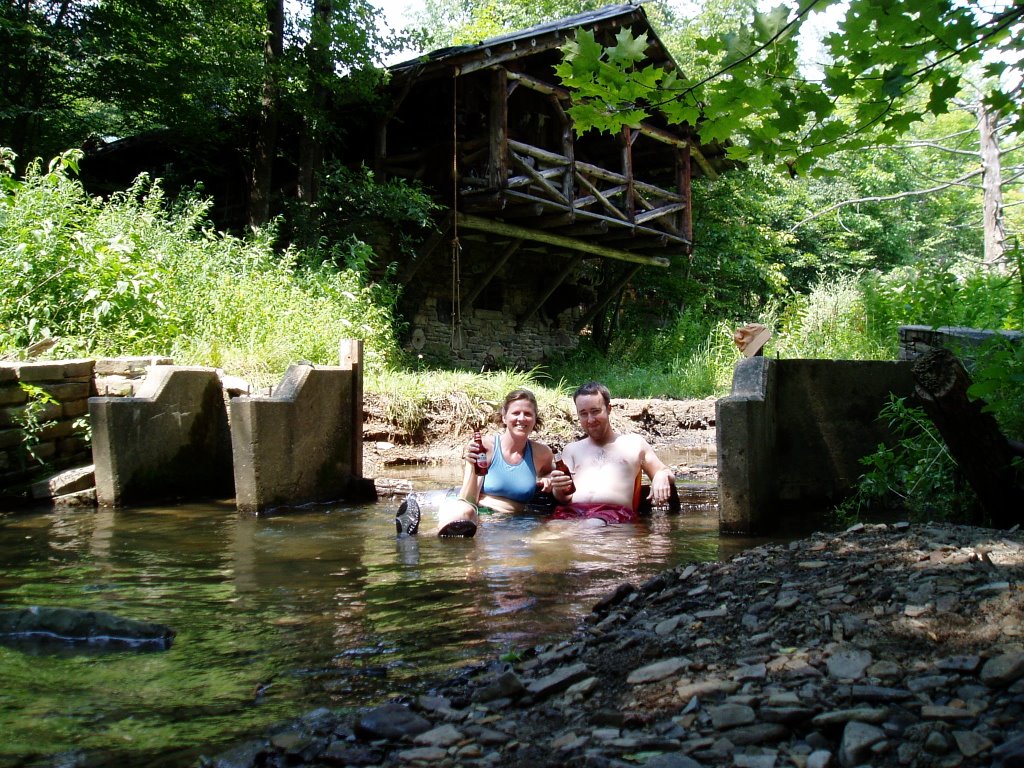
This summer, Sean and I wanted to spend our time in the woods again. Last summer it was in TN, this summer it was to cooler air in NY state. We went to Letchworth State Park with Jeff and Michelle from Waterloo, Ontario. Then traveled down a scenic road to the Pollywogg Holler for an Eco-Lodge experience we will never forget. Lastly, we traveled East to Hudson, NY to see Doug and Rachel. We had such an energizing time seeing old friends and making new ones.
Subscribe to:
Posts (Atom)